
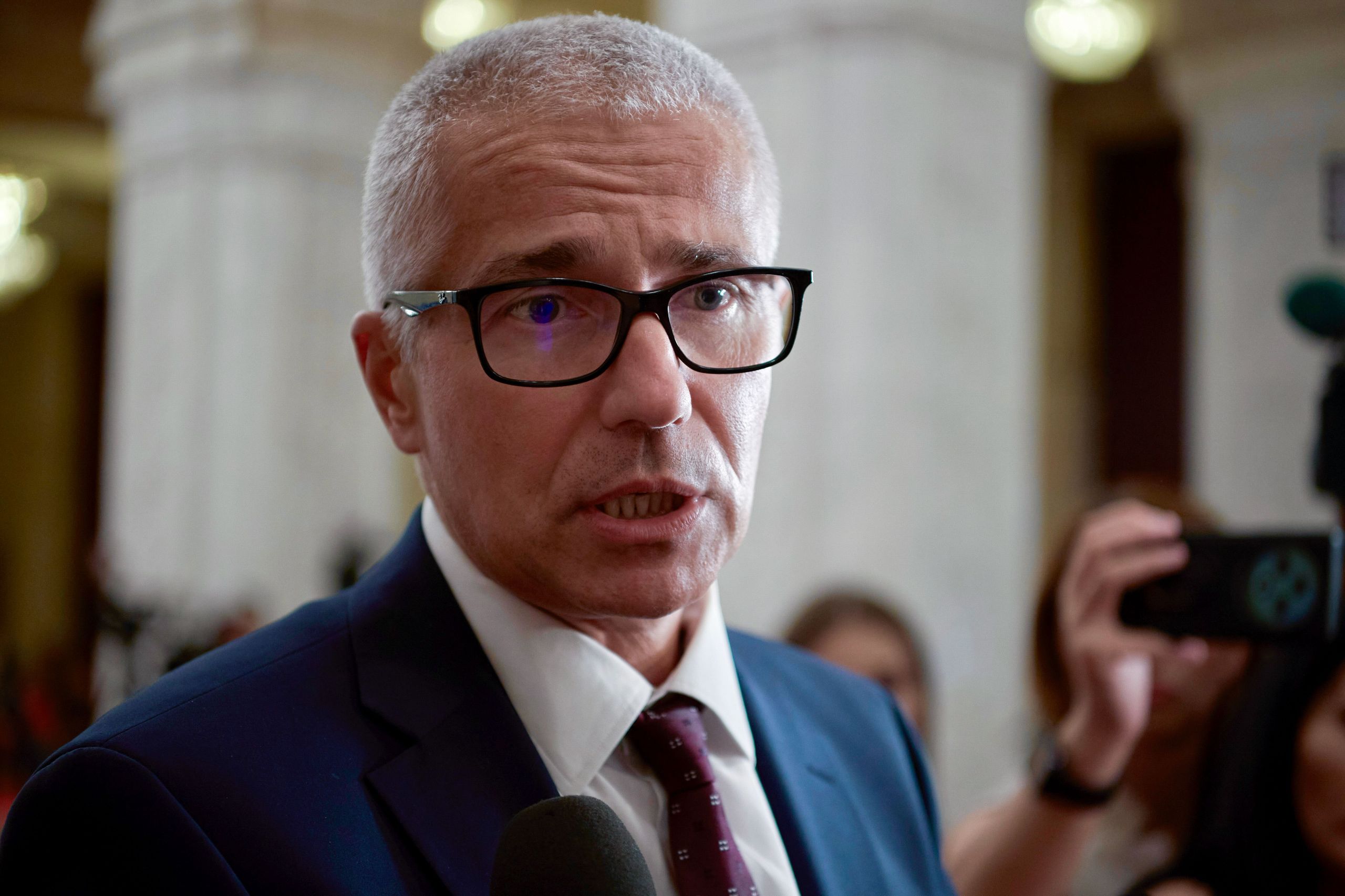
Justice Minister Radu Marinescu says he wrote his PhD thesis “under the conditions of the time” — a reference to 2009, the year he defended his doctorate. In 2009, in Romania, plagiarism was well regulated in both academic and legal terms. PHOTO: CODRIN UNICI / INQUAM PHOTOS
THE JUSTICE MINISTER’S PLAGIARIZED DOCTORATE. 140 pages of copied content in Radu Marinescu’s thesis

English Section
14/01/2026
More than half of Justice Minister Radu Marinescu’s PhD thesis in Law is plagiarized.
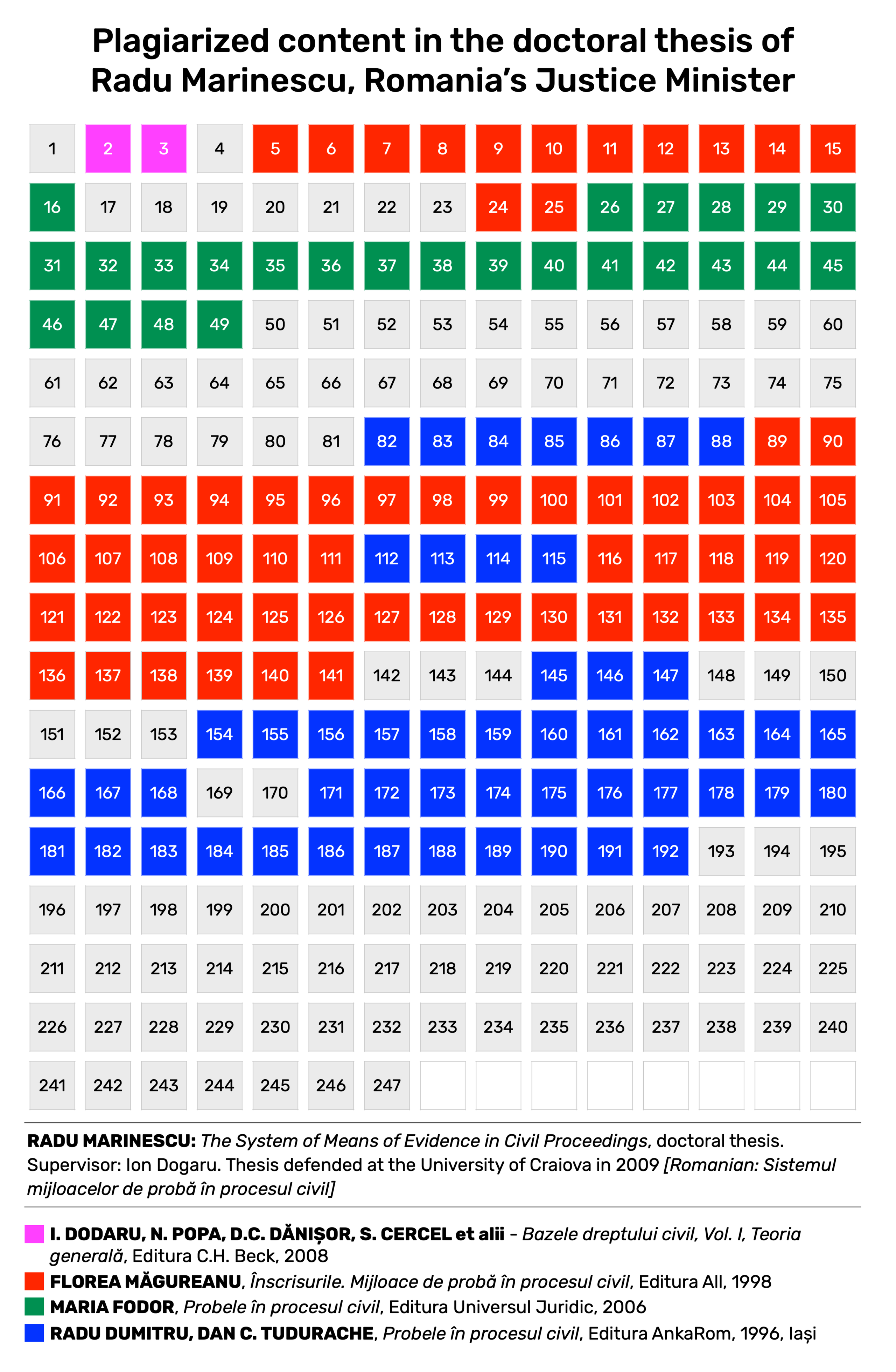
According to PressOne’s analysis, at least 56.68% of the pages of the work titled The System of Means of Evidence in Civil Proceedings contain text copied from other authors — specifically 140 pages out of the thesis’s 247 pages.
READ THE ROMANIAN VERSION HERE.
Radu Marinescu obtained his PhD in Law in 2009, at the Faculty of Law and Administrative Sciences of the University of Craiova, under the supervision of Professor Ion Dogaru.
Most of the plagiarized content comes from three other works, and in some cases the blocks of text taken word for word extend to as many as 25 consecutive pages.
In fact, the method of unauthorized borrowing used by the current justice minister is the most common one found in the doctoral theses of Romanian dignitaries: copy-paste plagiarism.
This method refers to copying a text word for word, without marking it with quotation marks — the signs that set off borrowed text — and without attributing it to the original author.
Minister Radu Marinescu denied, in a statement to PressOne, that he violated the standards for producing a scientific work: „I do not consider that I plagiarized. That’s what I can tell you.”
He also said he wrote his thesis „in accordance with the norms of the time and under the supervision of a reputable academic professor.”
Investigațiile și reportajele independente nu se fac din like-uri. Cititorii care le susțin financiar sunt cei care le fac posibile. Dacă prețuiești presa noastră, cu o sumă mică pe lună ne poți ajuta mai mult decât crezi. Poți face diferența chiar acum cu un singur click! Îți mulțumim!
Those „norms of the time” classified plagiarism as a form of academic fraud at the moment Marinescu defended his PhD thesis, in 2009 (including in law, not only in academic regulations).
Minister Radu Marinescu justifies academic theft by invoking — like an entire pleiad of plagiarists in public office who preceded him — an alleged „lack of norms” and an alleged „lack of legislation.” What Marinescu claims, in his discussion with PressOne, is false: in 2009, both academic norms and the law required that portions copied from other authors’ works be highlighted with quotation marks.
As for the academic reputation of the doctoral supervisor invoked by Marinescu, this does not absolve the author of the thesis anywhere in the world of responsibility for committing academic fraud.
A minister’s CV: law practice, university, politics
The current justice minister, who in 2026 will have a central role in appointing the chief prosecutors of the Prosecutor General’s Office, the DNA and DIICOT, graduated in Law in Craiova in 1995 and, after completing his traineeship, opened his own law office in Craiova in 1999.
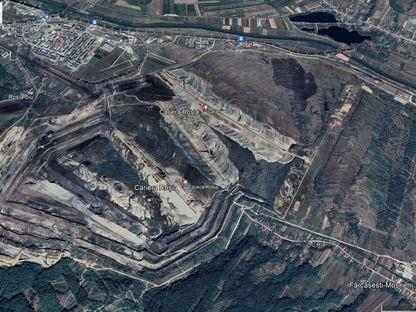
Coal Mining Expansion Leads to Deforestation: Over 470 Hectares of Forest Cut Down in Gorj, Romania
Over the past six years, more than 470 hectares of national forest land have been allocated by the government, without compensation, to the Oltenia Energy Complex (CEO) for the expansion or opening of new coal mines.

The not-so-green Romania. The state delays settlements for photovoltaic panels by 2 years
PressOne reviews the main dysfunctions in the production, consumption and distribution of energy from renewable sources, as revealed by discussions with consumers and data provided by official sources at the request of our editorial office.
His university career began one year before he defended his doctorate, according to his own CV: in 2008 he became a lecturer at the „Titu Maiorescu” University, the Târgu Jiu branch, where he continued teaching for a decade, until 2018. Since 2021 he has been an associate lecturer at the University of Craiova, the institution that awarded him the PhD title.
In parallel with his university career and law practice, Marinescu officially entered politics in 2016 — first in Craiova, where he became a local councilor during the period when Lia Olguța Vasilescu, one of the current PSD vice-presidents, was mayor, and then as a PSD MP, starting in December 2024.
As a lawyer, Marinescu defended Vasilescu in the case in which she was detained for 24 hours by the DNA on corruption charges, a case ultimately closed by anti-corruption prosecutors. Marinescu also represented Vasilescu’s husband, Claudiu Manda, in court in a case in which the High Court of Cassation and Justice found that the statute of limitations had expired after 15 hearings.
According to information that circulated in December 2024, when the Ciolacu II cabinet was formed, Radu Marinescu was allegedly proposed and supported for the position of justice minister by Lia Olguța Vasilescu, who is a PSD vice-president.
His ministerial term, which began after the tension of the December 2024 parliamentary elections, was marked by the lowest level of trust in the judiciary in the past decade.
2008–2018: A decade as a tenured university lecturer
Although in his official CV, uploaded on the Justice Ministry’s website, he clearly indicates ten years (2008–2018) of university activity as a lecturer at „Titu Maiorescu” University, in his discussion with PressOne Radu Marinescu downplayed this decade-long period, calling it „a short period.”
Moreover, Marinescu claimed that the plagiarized PhD brought him no benefit in his career, although he confirmed that at „Titu Maiorescu” University he was a tenured lecturer. This position cannot be held, according to academic standards, without a PhD.
„I was tenured there,” Marinescu confirms in the interview with PressOne:
Emilia Șercan: In your CV it says you were a lecturer. You write in your own CV that you were a lecturer at the University…
Radu Marinescu: „Titu Maiorescu,” for a short period of time. A private university.
E. Ș.: A short period of 10 years. That’s what your CV indicates, a short period of 10 years.
R. M.: Yes, that is the period mentioned in the CV. I had no reason to hide in my CV the activity I carried out.
E. Ș.: But were you a tenured faculty member? Because it only says „lecturer” there. Were you tenured at this university, or only a collaborator?
R. M.: No, I was tenured there.
E. Ș.: Ah, so you sat the competition for the position, you were a lecturer…
R. M.: I repeat, at the time… But, once again, Ms. Șercan, if you have doubts regarding my activity, once again, you can submit it for examination by the authorities who can rule on this matter. I have nothing else to comment.
E. Ș.: Understood. But I would still like to clarify, because I have the opportunity [of this discussion] with you. Now are you a collaborator at the University of Craiova, or are you a tenured faculty member?
R. M.: No, only a collaborator, Ms. Șercan. I don’t hold a university chair.
E. Ș.: And during the period since you became minister, have you still taught classes or did you suspend them?
R. M.: No, I did not suspend them. I have taught online classes.
E. Ș.: So you taught online. Understood. And there is one more thing I would like you to help me understand. Also in your CV you say you had a training internship or… in Tilburg, in the Netherlands. What, exactly, happened there and in what period did it take place?
R. M.: It was a student exchange and I took courses at Tilburg University in the field of international law and European law.
E. Ș.: For what period?
R. M.: As far as I remember, one month or two months. Honestly, it’s been a very long time since then.
Plagiarism starting with the „Foreword”
The doctoral thesis of the current justice minister, Radu Marinescu, is plagiarized from the very first page.
In the section titled „Foreword” — in which the author presents his own argument regarding the research carried out — more than half a page is taken without quotation marks from the volume Foundations of Civil Law, General Theory, Vol. I, a work published in 2008 and signed by Ion Dogaru, Marinescu’s doctoral supervisor, together with Nicolae Popa, Dan Claudiu Dănișor, Sevastian Cercel and others.
Dogaru, Dănișor and Cercel were all deans of the faculty that awarded Marinescu the PhD title.
Radu Marinescu mentioned several times, in the context of the discussion with PressOne about plagiarism, that his PhD thesis was supervised by a reputable academic, Ion Dogaru, who was a corresponding member of the Romanian Academy — and who co-authored the book from which Marinescu copied. The reputation of a doctoral supervisor does not absolve the author of a plagiarized work of responsibility, however.
The rest of the content found plagiarized in Radu Marinescu’s PhD thesis, titled The System of Means of Evidence in Civil Proceedings, comes from three other works published before its defense in 2009.
First source
Most of the content identified as plagiarized in Radu Marinescu’s doctoral work comes from a volume that was not cited even once throughout the entire thesis and was not included in the bibliography.
The volume is titled Documents. Means of Evidence in Civil Proceedings, published in 1998 by All Publishing House, signed by Florea Măgureanu — a former university professor at the Faculty of Law of the Romanian-American University.
This accounts for 62 pages out of the 140 pages containing plagiarized content.
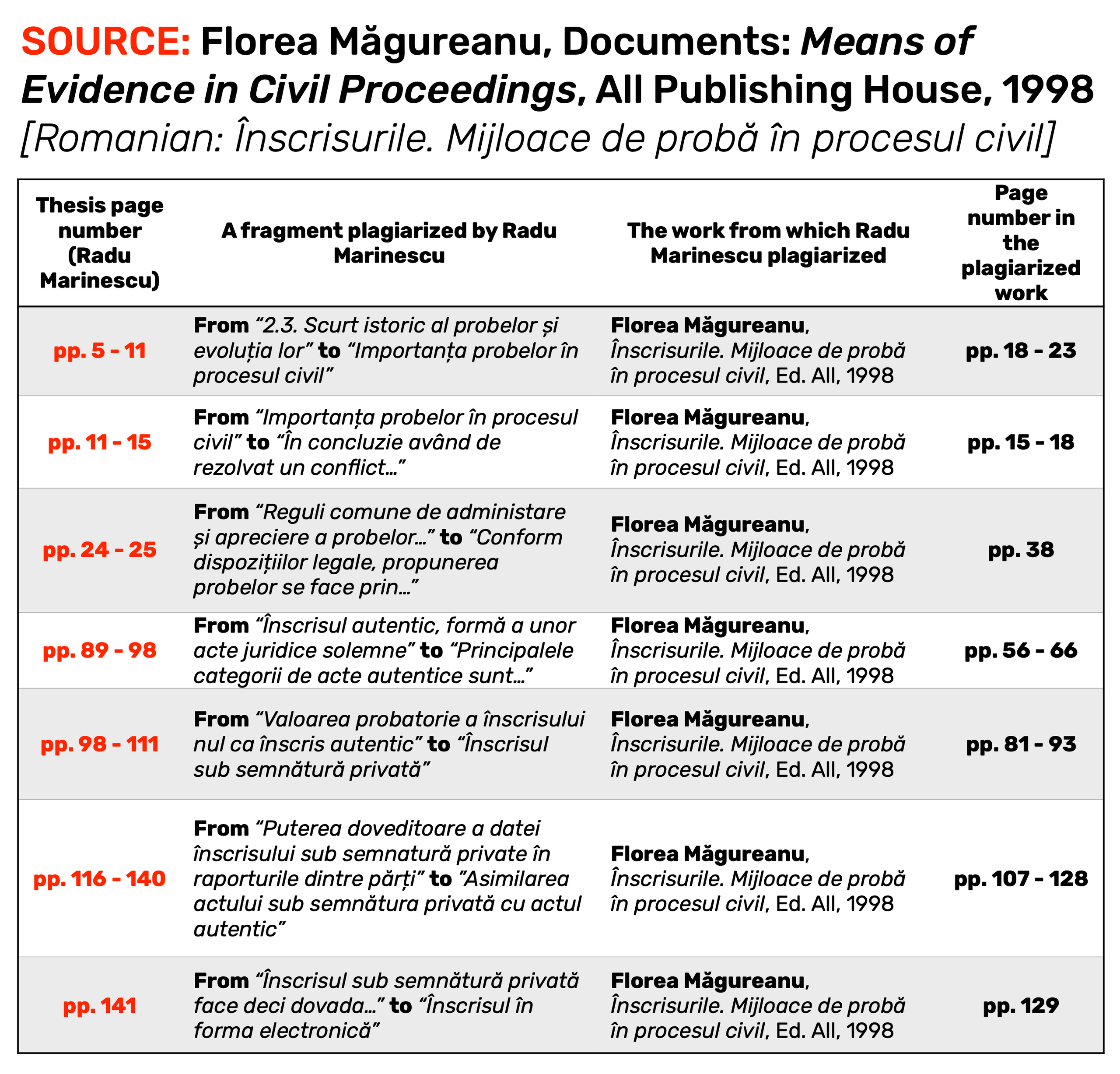
The first sequence of text taken from Măgureanu’s work — which is his own PhD thesis, defended in 1997 at the Faculty of Law of the University of Bucharest — covers pages 5–15 of Marinescu’s thesis.
From page 5 to 11 there is a section titled „Brief history of evidence and its evolution,” which is plagiarized word for word from Florea Măgureanu’s work.
The current justice minister does not reproduce in his thesis the footnotes from the original work, where Măgureanu cited authors who had previously researched the history of evidence.
Instead, in the next plagiarized text sequence, spanning pages 11–15, Marinescu also copies the footnotes from Măgureanu’s work.
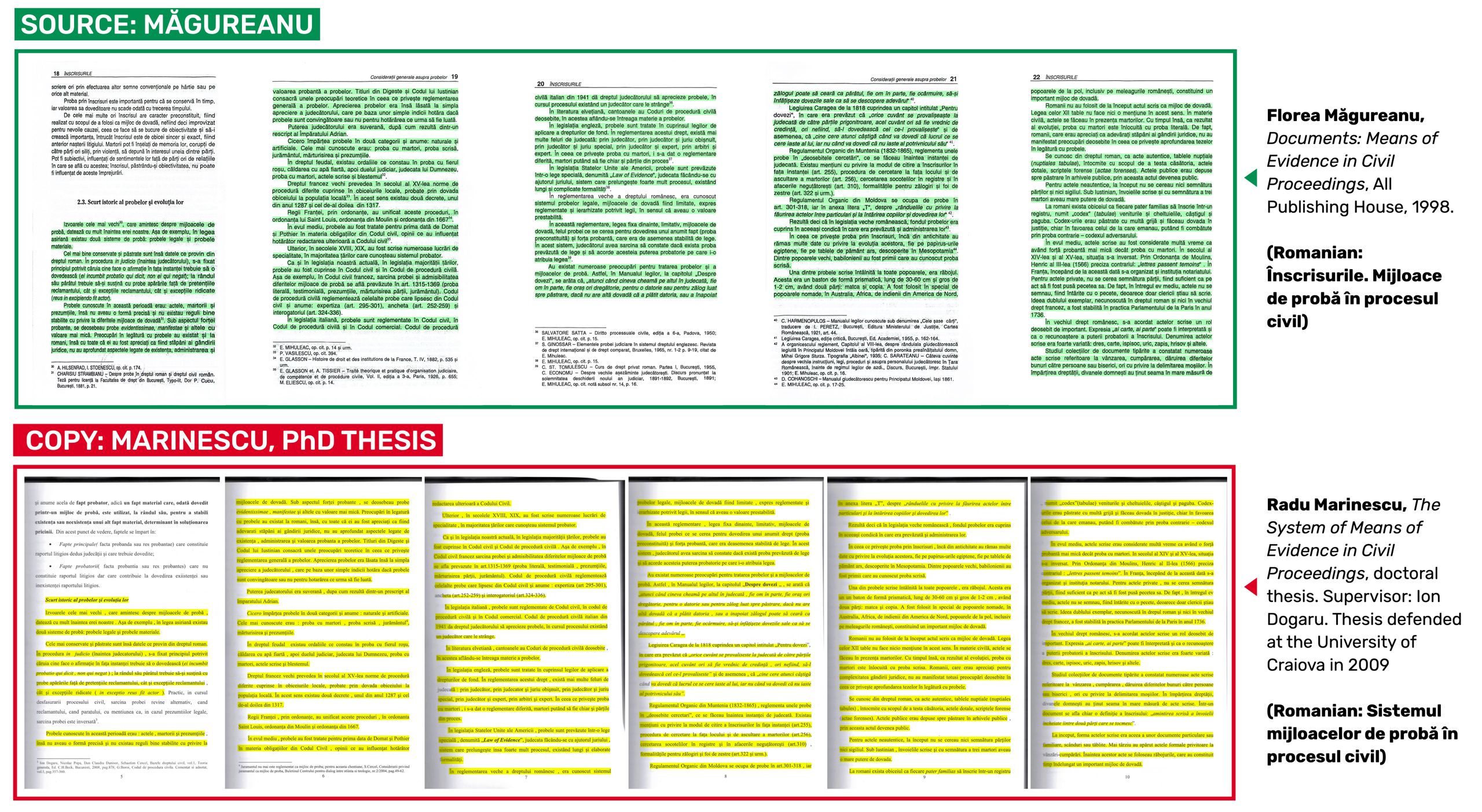
The plagiarized text sequences from Florea Măgureanu’s work have a different graphic appearance from the rest of the content in Radu Marinescu’s thesis.
In addition, the 62 plagiarized pages are marked by poor punctuation, with spaces inserted incorrectly before and after punctuation marks, inconsistent spelling, or typing errors.
The differences in graphic appearance and the fact that certain typing errors appear only in some portions of the thesis suggest that the transcription of the plagiarized sequences from Florea Măgureanu’s work may have been done by another person and that, afterward, the signatory of the thesis did not carry out even a minimal review of the text.
Second source
Another work from which Radu Marinescu plagiarized is titled Evidence in Civil Proceedings and was published under the signature of Maria Fodor by Universul Juridic Publishing House in 2006.
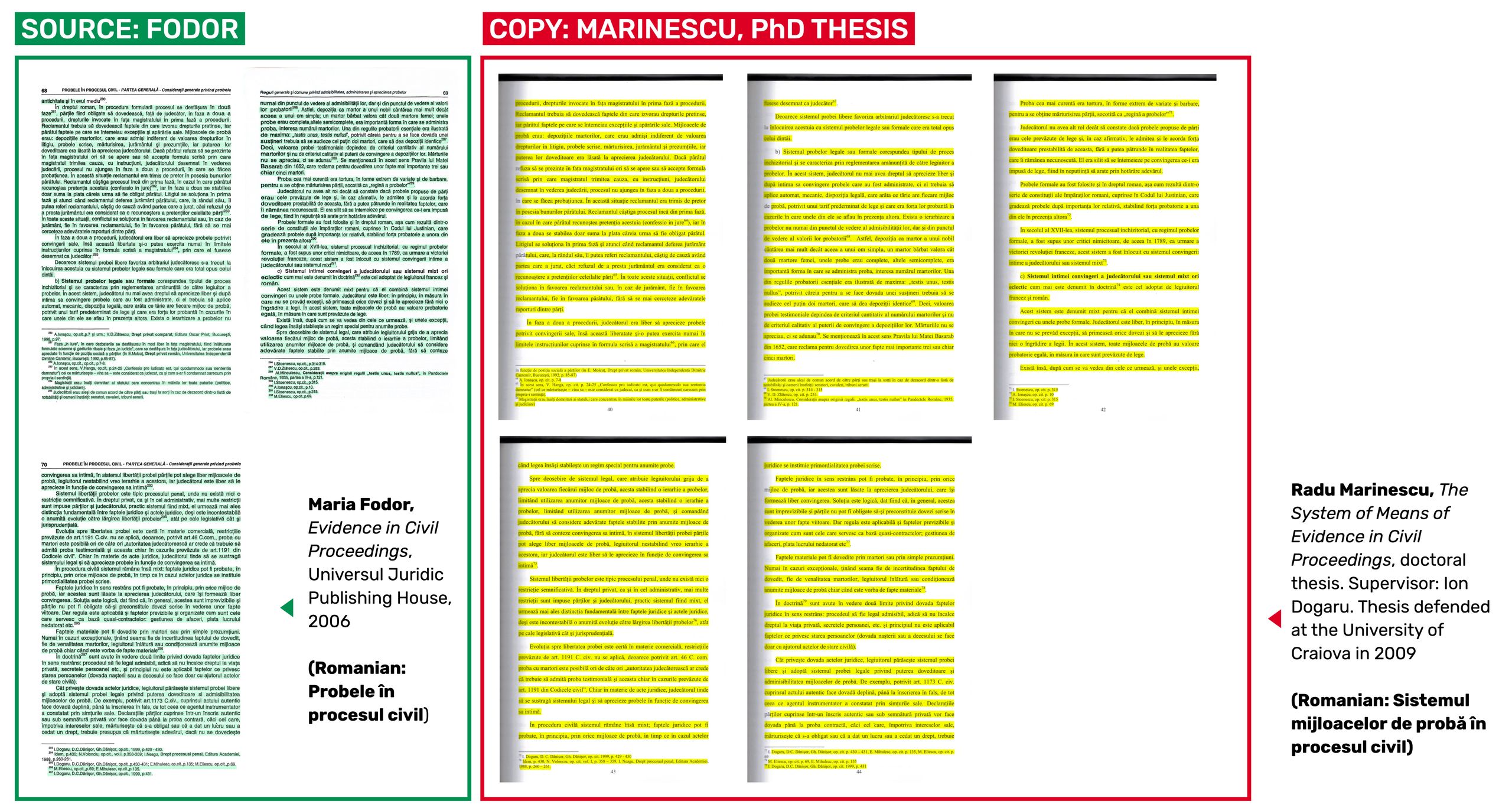
The 26 pages of text plagiarized from this work in the justice minister’s thesis were copied together with the footnotes.
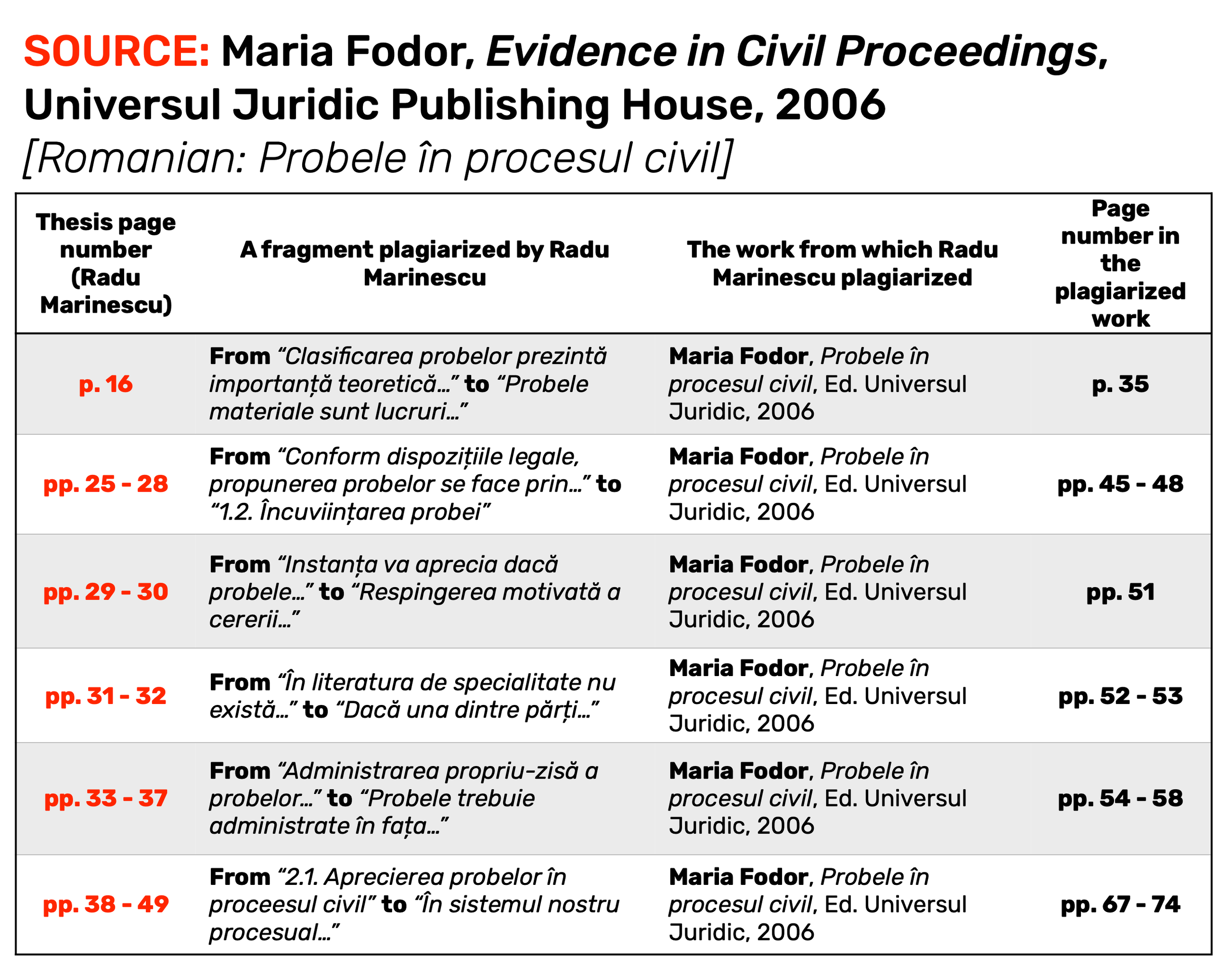
Beyond the content itself, plagiarized word for word from Fodor’s book, the text taken from this author provides another crushing proof of plagiarism.
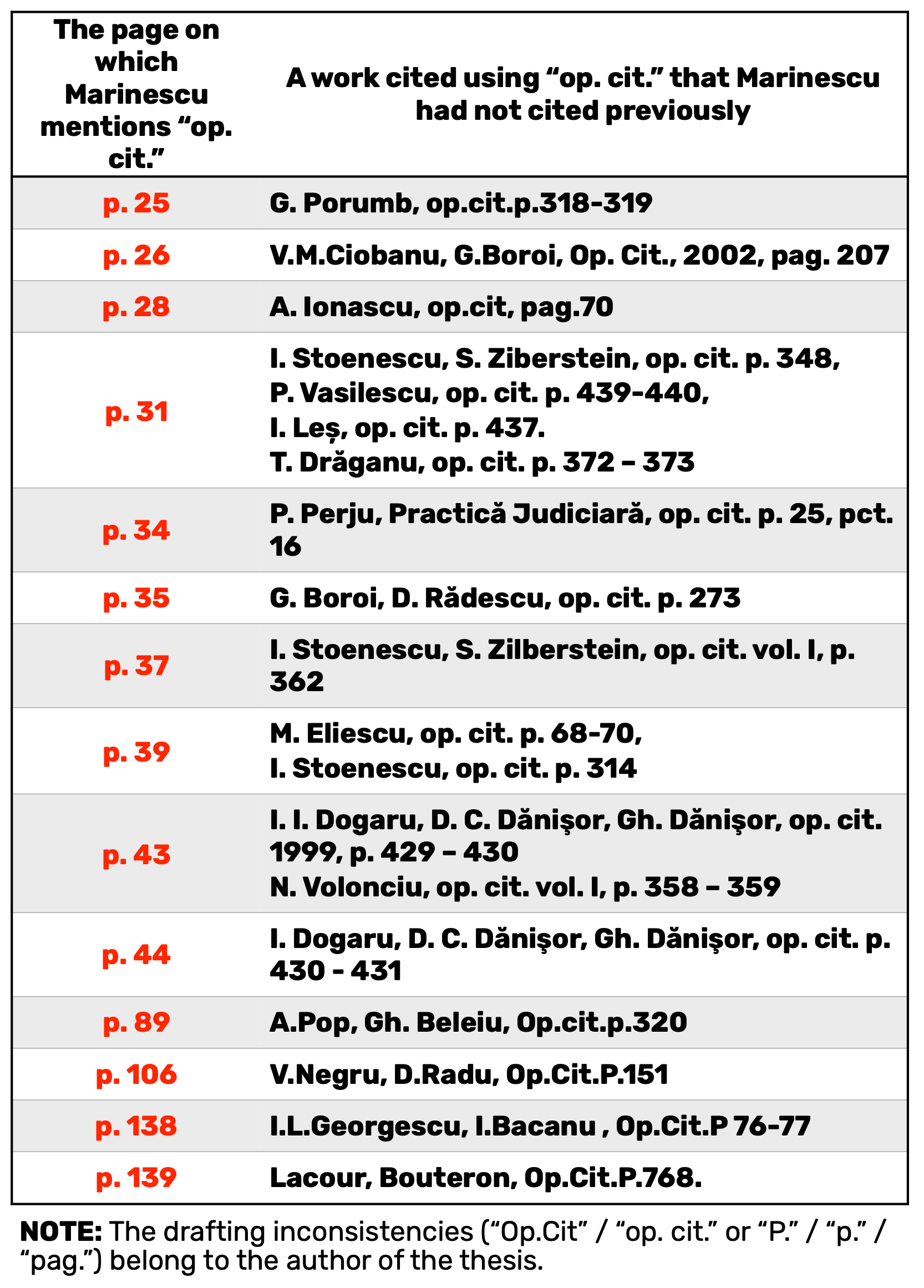
In 15 footnotes in Marinescu’s thesis, found from page 25 to page 44, the cited authors are marked with the abbreviation „op. cit.,” which comes from Latin — opere citato — and means „in the work cited previously.”
This citation convention allows an author not to repeat, in a future footnote, the full name of a work, the year and the publisher, but to mention only the author’s name and the page where the content is found, whether taken by direct quotation or paraphrase.
This convention is permitted only if the source has been cited previously.
In Marinescu’s case, the 15 works cited through the abbreviation „op. cit.” had not been mentioned earlier, which shows in an indisputable manner that those pages are plagiarized.
Maria Fodor’s work — Evidence in Civil Proceedings — was included in the bibliography, but it was cited only once in a footnote (footnote 43 on page 32), even though 26 pages from its content were plagiarized in Marinescu’s thesis without being properly marked with quotation marks.
Third source
Another 53 pages of Radu Marinescu’s doctorate are plagiarized from the work Evidence in Civil Proceedings, published in 1996 by AnkaRom Publishing House in Iași and signed by Radu Dumitru and Dan Tudurache.
The work was not cited even once in the entire content of the justice minister’s doctoral thesis and was not included in the bibliography.
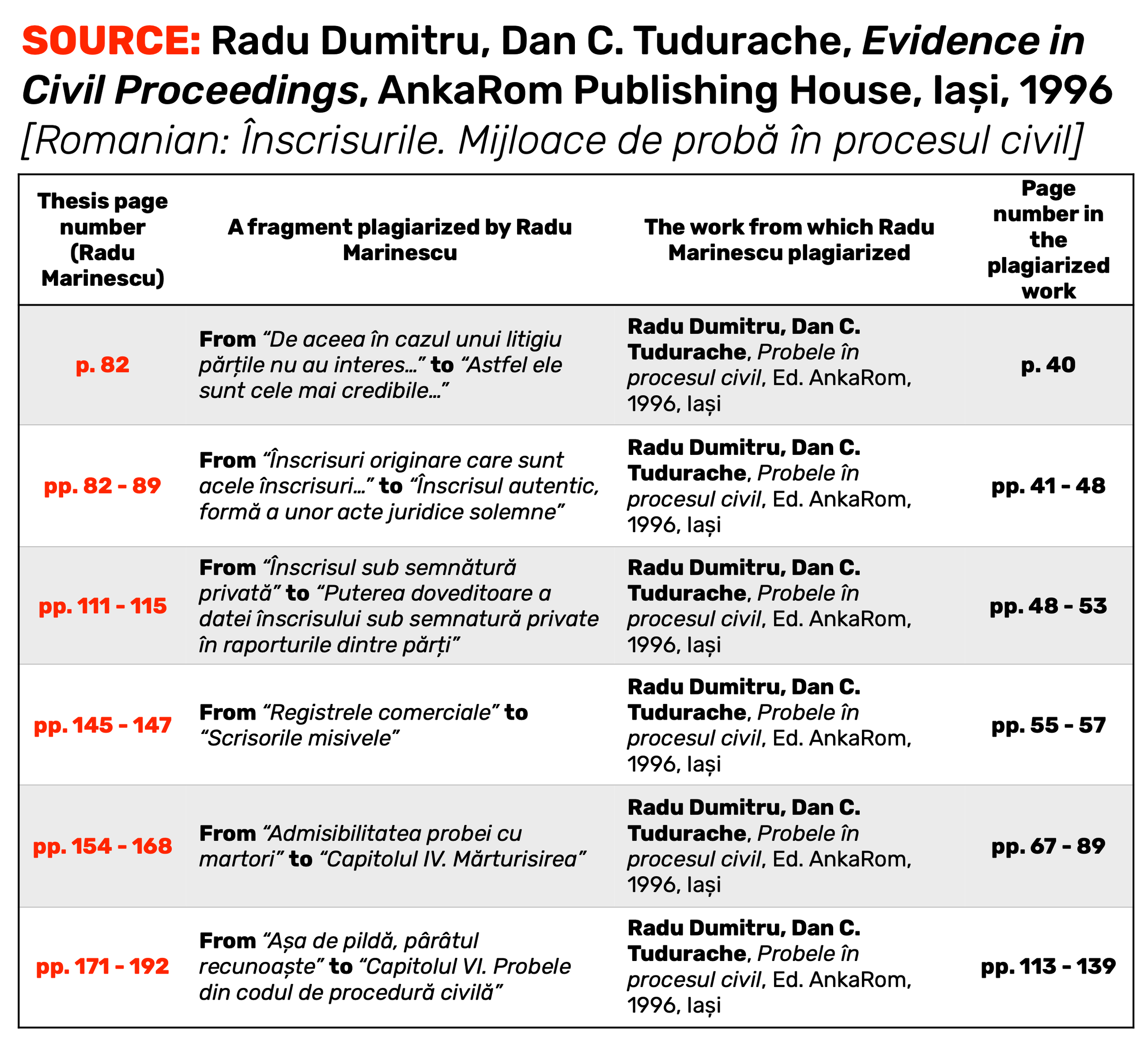
If in the case of the text plagiarized from the works of Florea Măgureanu and Maria Fodor the plagiarism is faithful, copy-paste and without any intervention in the text, this time there is a series of minor rephrasings.
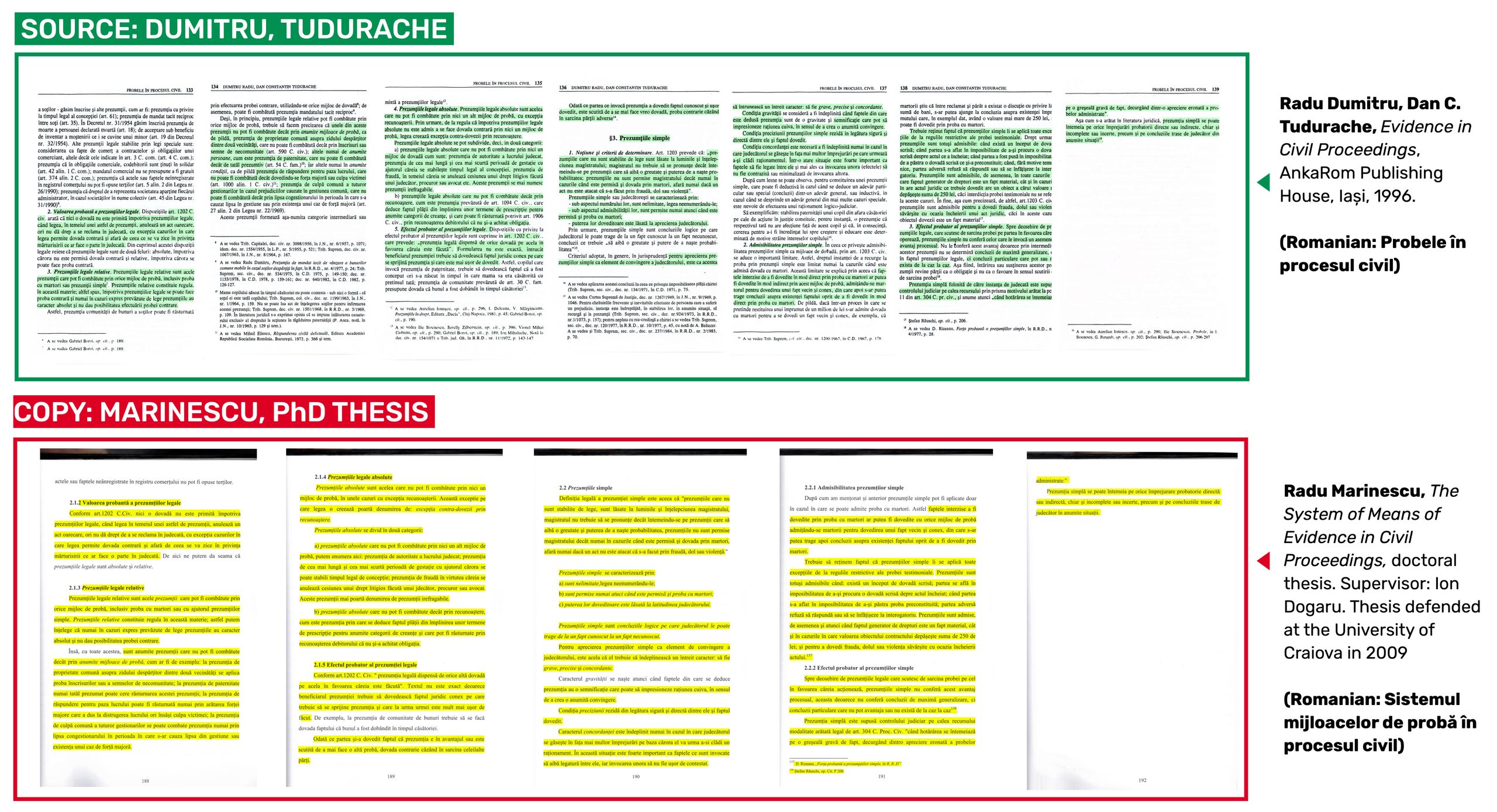
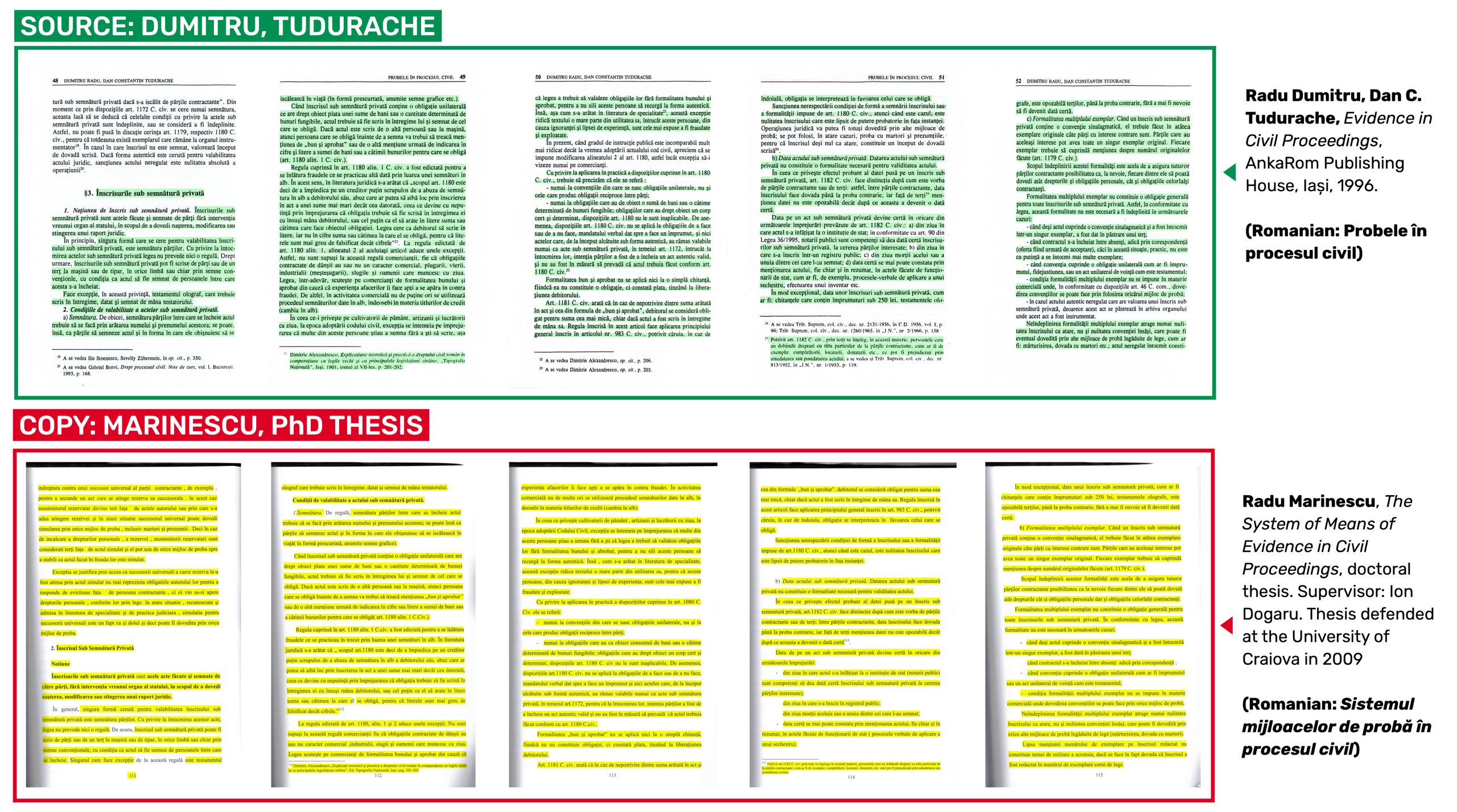
Given this significant difference in the way the content from Dumitru and Tudurache’s work was copied into Marinescu’s doctorate, there are two possible explanations:
- either the text was indeed rephrased by Marinescu;
- or the source of the plagiarism is another unidentified work, in which text from Dumitru and Tudurache’s volume was also plagiarized.
Regardless of which variant is correct, one thing is certain: the content of those 53 pages in the justice minister’s thesis had been published earlier, as far back as 1996, in the work Evidence in Civil Proceedings. Even if some sentence openings are slightly rephrased through synonymous constructions, the plagiarism remains obvious.
***
None of the three works plagiarized by Minister Marinescu has been digitized, so the clues of plagiarism were discovered directly in the printed version of these volumes.
If Radu Marinescu’s thesis were checked with similarity-detection software, it would not discover the source of the plagiarism, because such software can analyze only works available online.
In 2021, the Ministry of Education, led by Sorin Cîmpeanu, allocated 25 million lei to universities to develop a strategy and to check doctoral theses awarded in the period 1990–2016 for the existence of plagiarism.
In a reply from November 2023 sent to PressOne, the University of Craiova stated that by that time 123 doctoral theses defended in the period 1990–2000 had been digitized, without any doctoral thesis actually being checked for plagiarism at that date.
The decision to analyze doctoral theses is useless in situations where the plagiarized content comes from works that have not been digitized themselves and cannot be found online. In other words, software cannot compare a work available in printed format with a digital one.
***
It is unlikely that Radu Marinescu had access to an electronic version of the works from which he plagiarized. Two of them were published before 2000, specifically in 1996 and 1998.
As I have already explained, there are multiple indications that the text sequences were transcribed from the printed versions by different people, who made different types of punctuation and spelling errors. One example: the thesis has portions written with diacritics and portions in which diacritics are missing.
Beyond the identity of content between Marinescu’s thesis and the works presented above, there are also other clues that attest to the undeniable existence of plagiarism in the justice minister’s thesis.
In some cases, he even reproduced the indentation from the original, whether certain quotations marked in italics, or certain words highlighted in bold or italics, just as they appeared in the original.
Probably the most crushing proof of plagiarism — beyond identical content — is shown by the citation system used in Radu Marinescu’s thesis, which differs depending on the works from which he plagiarizes.
In some situations, he did not reproduce the footnotes from the original works — where the authors cited in the original are mentioned — while in others he reproduced the content of the notes identically.
Large sections of the thesis, however, have no citation system at all, which is abnormal for a PhD thesis. For example, from page 52 to 83 and from page 115 to 136 no citation system is used.
In any scientific work, the citation system must be consistent. In Radu Marinescu’s thesis, he uses the footnote system — specific to legal sciences — but on pages 78, 79 and 135 there is one author cited in parentheses on each page.
***
The work compromises the very idea of doctoral research
Marinescu’s work completely compromises the idea of doctoral research and a PhD thesis and calls into question the credibility of the academic procedures that allowed it to be validated.
In the body text of Radu Marinescu’s thesis there are references to certain footnotes, but the notes are missing from the bottom of the pages. This shows that the content was copied mechanically, and the author omitted — intentionally or not — to transcribe the explanatory content of the footnotes as well.
For example, on page 35 in the text there is a reference to footnote „2,” which has no detailed content at the bottom of the page, yet on the same page footnotes 49, 50 and 51 appear, which do have detailed content at the bottom.
An identical situation is on page 80, where footnote „43” is included in the text but not at the bottom of the page. On page 86, footnote „1” appears in the text, which has no correspondence at the bottom of the page.
Also, on page 216 there is footnote „10,” and on page 228 there is footnote „33,” which likewise have no corresponding citation content at the bottom of those pages.
Another clue indicating that the thesis is plagiarized concerns the age of the cited sources, relative to the year the thesis was defended.
Many of the cases indicated in the footnotes are from the communist period — some even from the 1950s or 1960s — even though the thesis, defended two decades after the fall of communism, did not have as its theme research into the pre-1989 period. The explanation for the age of the sources is that the authors plagiarized by Marinescu had themselves taken those cases from volumes published before 1989, while transparently indicating their origin.
How Minister Marinescu justifies the 140 pages of plagiarized content
PressOne contacted Minister Radu Marinescu by phone on Sunday, 11 January. He denies having plagiarized in the doctoral thesis defended in 2009.
Radu Marinescu: I am a graduate of a reputable faculty within the „hexagon” of law faculties (the University of Craiova — ed.). I finished as valedictorian, I entered the bar among the first, and I wrote the doctorate at the same university where I finished my studies, in accordance with the norms of the time and under the supervision of a reputable academic professor, may God rest him, Mr. Ion Dogaru. I repeat, I wrote this thesis in accordance with the rigor of the moment and under the guidance of the supervising professor.
Emilia Șercan: OK, what does „the rigor of the moment” mean? What do you understand by „the rigor of the moment”? Did „the rigor of the moment” say you didn’t have to cite?
R. M.: Ms. Șercan, I believe I respected all requirements and, I repeat, I worked under the supervision of the guiding professor. If you have elements, question marks, absolutely you can make any kind of journalistic démarche that you consider appropriate. You can request clarifications that can be carried out by the competent bodies. I do not consider that I plagiarized. That’s what I can tell you.
E. Ș.: You said you wrote the thesis under Professor Dogaru’s supervision. You left me with the impression that you somehow place responsibility…
R. M.: No, God forbid! So no, don’t put words in my… You asked me in what context I wrote it. I had a supervisor, naturally, a supervising professor. This thesis went through the evaluations carried out at ministerial level, you know very well what the process is. There was no kind of question mark, no doubt was signaled to me. I would have had no reason not to cite someone. I did not have a university career, a university chair, I never sought that…
E. Ș.: Regarding the checks we made, we found as many as 25 consecutive pages taken from a single author. Obviously, without citation, without that work even being included in the final bibliography, without it being mentioned anywhere in the thesis.
R. M.: Once again, Ms. Șercan, I can only tell you this: I wrote the thesis under the conditions of the time, under a professor’s supervision. It went through the evaluations done at the Ministry, through the commission there. I was not signaled any kind of inconsistency at all. Consequently, I repeat, I am not a person who in life has relied on a benefit obtained dishonestly. I was a lawyer for 30 years, I worked in my activity. I repeat, the university career was not for me a target, a stake. I do not hold a university chair, so I have nothing particular to defend…
E. Ș.: But what do you think should happen regarding situations where there are plagiarized doctoral theses in Romania? You are, after all, the justice minister. Justice itself means fairness and correctness as a principle.
R. M.: Fairness, correctness concerns the whole society. I repeat, if something is to be established, it must be established by the competent bodies. Not me, not you, not anyone else. If you have suspicions, it can be checked by the authorities and it can be established whether there was or was not something wrong. That’s what I can tell you.
Key role in appointing the heads of prosecution offices
The year of Radu Marinescu’s term as minister coincides with a palpable collapse in citizens’ trust in the judicial system — which culminated, in December 2025, in a wave of public anger coalescing around the revelations in the Recorder documentary „Captured Justice.”
The documentary signed by Andreea Pocotilă and Mihai Voinea, which exposed to the general public some of the invisible mechanisms through which the judicial system lets major corrupt figures off the hook, exceeded 5 million views on YouTube alone. That means more than a quarter of the country’s population.
The wave of acquittals and releases from detention of people accused of blatant violations of the law entrenched, at public level, the idea that if you are wealthy and politically connected, supposedly „independent” justice can let you escape through a multitude of obscure levers and complicated mechanisms that are hard to understand from outside the system. A word that was not part of common vocabulary, „impunity,” began to circulate in public conversation.
In this context, in which only 24% of Romanians still have high and very high trust in the judicial system — according to a CURS poll from December 2025 — Minister Radu Marinescu has the mission of selecting the future heads of the most important prosecution offices in the country: the Prosecutor General’s Office, the DNA and DIICOT.
Marinescu, moreover, triggered last week the procedure for appointing the heads of the major prosecution offices. His proposals will be sent first to the Superior Council of Magistracy (CSM), whose opinion is consultative, and the actual appointments are to be made by President Nicușor Dan.
G4Media and Digi24 report, citing their own sources, that the positions of chief prosecutors, along with those for the leadership of the SRI and SIE, are to be negotiated by President Nicușor Dan with PSD representatives. It is not clear at this moment whether the negotiations will also include the other parties in the current governing coalition.
The previous appointments, proposed in 2023 by former Justice Minister Cătălin Predoiu (PNL) and validated by former President Klaus Iohannis, all contributed to the collapse of trust in the judicial system.
The former head of DIICOT, Giorgiana Hosu, who was from the start of her term in an obvious conflict of interest, ended up resigning after her husband was convicted; the head of the Prosecutor General’s Office, Alex Florența, has an entire portfolio of closed cases in which political decision-makers were involved, cases later reopened through final rulings; and the head of the DNA, Marius Voineag, a central figure in the Recorder documentary, became the most contested head of the DNA in the institution’s history.
Marinescu, a member of the executive, has stood out for ambiguous statements at best. On the reform of magistrates’ special pensions launched by the Bolojan government — of which Marinescu is a member — he sent public messages aligned rather with magistrates who oppose the reform and with the PSD, the party he belongs to.
Regarding the overt boycott by the four Constitutional Court judges proposed by the PSD — who prevented the Court from ruling, on 28 and 29 December, on the constitutionality of the law reforming magistrates’ pensions — Marinescu said it is „a bit paradoxical.”
The only justification for the „paradox” offered by Marinescu for this unprecedented constitutional boycott in Romania’s recent history: the four judges who, through their absence, prevented the formation of a quorum, in fact have no obligation of loyalty to the PSD, the party that nominated them, even though they were appointed on the basis of a „political algorithm.”
Editor: Mona Dîrțu
Ți-a fost util acest articol? Ajută-ne să facem mai multe.
Investigațiile și reportajele independente cer timp, documentare și bani. Nu depindem de partide sau interese ascunse, ci de cititori ca tine.
Susține jurnalismul independent cu minimum 5€/lună. Devino abonat acum și ne ajuți mai mult decât ai crede. Îți mulțumim!
Share this